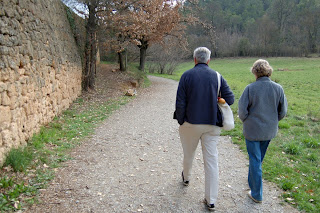
The real shocker is that all four of us were in upbeat moods throughout the morning that we explored Carcassonne. That was quite a change from the two previous days, at Pont du Gard and Peyrepertuse – both which I now know to be among the most visually awesome places for any parent to spend his time wishing that he could legally thrash the hell out of his determinedly grouchy daughter.
Yes, Jasper is precocious. She's still only 8 years old, but increasingly she acts like she's 12 or 13. And I mean that, obviously, in the least positive way possible.
Of course, if you asked her, she'd assure you that the cause of her sullen displeasure can be traced to me and my Draconian parenting practices. Regardless, it was irritating. And aesthetically frustrating: Jasper's been regularly wearing a red sweater that just happens to look dynamite in photos – a great wet splash of color to punctuate the monolithic earth-tones of all these ancient ruins – but she vigorously refused to be photographed. When she'd see me with my finger on the shutter, she'd bolt immediately from wherever she'd been so picture-perfectly posed and flee, as fast as she could, up some flight of stone steps.
But at Carcassonne, Jasper was all smiles as she cheerfully characterized the legendarily well-preserved medieval city to be "kind of boring." I didn't find it boring. With its turrets and portcullises and throngs of camera-toting tourists, Carcassonne is like some sort of derelict Disneyland. And even though the castle is a UNESCO World Heritage site, it's still part of the living urban landscape, full of retail shops and restaurants and motorcycles zooming over historic drawbridges and diesel trucks rumbling down medieval alleyways barely big enough for a bicycle. As a pedestrian and parent to two distractable children, I didn't find that boring at all.
That's something that I really get a kick out of here in France: the way that deeply historical stuff is taken for granted; the way it's just part of the ordinary landscape.
Traveling around France, or even just walking around Cotignac, I'm reminded of the phrase that V. S. Naipaul famously used to characterize the American south: "a landscape of small ruins." During the times that I've traveled around North Carolina and other southern states, I've really resonated to those regular bits of ordinary wreckage – old barns overgrown with kudzu, uneven porches being slowly shattered by wisteria, that sort of thing. But, if anything, "a landscape of small ruins" is an even more apt description of southern France. I mean, sure, there are plenty of impressive huge ruins here too – immense displays of ancient architecture like the Pont du Gard and all, blah blah blah. But it's the countless little ruins – the ones we see everywhere – that I dig so much on a daily basis: The crumbling mill at the edge of a village; the half-collapsed hilltop chapel; the cylindrical remnants of abandoned wells amidst the rocks and rangy weeds of almost every orchard. At an intellectual level, it's humbling to encounter these constant casual reminders that, no matter how sturdy we might try to make the things we make, our things are ultimately no match for the rain and the wind and the sun. And there's also something so aesthetically pleasing in these juxtapositions of engineering and entropy: I just like the way they look.
The big ruins look pretty great too, and even Jasper's headstrong grumpiness was no match for the dilapidated awesomeness of Peyrepertuse – which, with its dizzying mountaintop location and sharp geometries, has an almost Machu Picchu-like quality about it. Hours later, after we'd returned to the cramped little "camping" cabin where we spent the night, Jasper snuggled up to me as I downloaded that day's photos onto my laptop, and she giggled in amusement at the pictures that I had taken of her attempts to avoid being in the pictures I was taking. And then we looked at them again, and she laughed out loud all over again, and so did I.


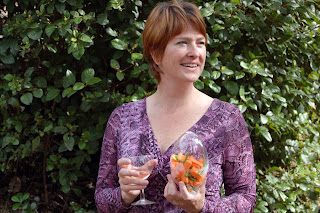 We just got back from a 3-day trip to Cathar country, also known as the “country of countries” because the south of France in the middle ages was a bunch of independent city-states. There are many cool castle-like sights to see, from crumbling ruins (Peyrepertuse) to still-lived-in cities (Carcasonne). Mark will be blogging about this too. I mostly want to say that I loved this trip. My favorite day was the day we drove to Peyrepertuse and back. We (accidentally) had no paper map with us at all and were relying entirely on our GPS (have I mentioned how much I loooove my GPS?). it was really kind of fun to have no idea where we were, where we were going, or how we were going to get there, but still being totally relaxed about it. I realized it was like having a local in the car telling us which way to go. We were on lots of tiny roads and the country was varied and gorgeous. For her own mysterious reasons, Madamoiselle TomTom (what we call our GPS) took us on one route on the way there and a different route on the way home. It was great. It was like we toggled a “take us on a scenic round trip” button on accident.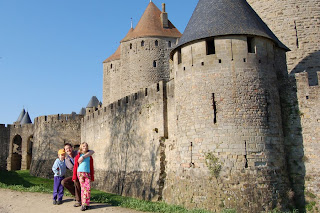


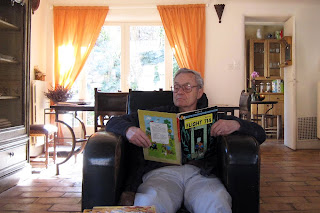 In addition to Tintin and delicious sludgy restaurant food, I kept my parents intermittently entertained with walks around Cotignac. On one walk I picked a bunch of wild asparagus growing by the roadside and, despite my mom's contention that it'd be coated in dog urine, I served it up for dinner. We also played a lot of table tennis. My dad used to be a ping-pong demon during his undergraduate days – almost 60 years ago – and he seemed to enjoy the opportunity to once again throw down some topspin-heavy forehand smashes. My mom holds her own at the table too, and the mere act of palming a paddle again brought forth a flood of proud recollections her about sporty teenage years. You probably didn't know, for instance, that she had the highest bowling score among all the girls in her gym class.